Showing posts with label adding on an old house. Show all posts

Tuesday, July 29, 2025

Village Dutch Colonial Addition


When I design an addition to a historic home, especially in a traditional, village neighborhood, I want to make sure the new does not feel incongruous within the established surroundings. This means careful consideration of roof shape, window size and placement, and material selection, among other things.


This Dutch Colonial was small (1520SF before our addition) and the owners loved the old house character and didn't mind the small footprint, but they longed for a bit more space: a larger kitchen and entry space, a second bathroom, and a space for the washer and dryer to not be in the basement.  They wished for a larger bedroom with larger closets, and a better connection to the back yard. And they were adamant that the new addition look appropriate from both inside and out- so they hired me! The new addition spans across the entire back of the home and adds 278SF to the first floor and 170SF to the second floor, making the whole home now just under 2000SF. (still quite modest compared to a "typical" American homes for a family of four) 

New Back Door
View toward Bathroom from Laundry


The door to the back, that used to connect to the basement stairway, (see before photo above) was removed and the cellar stair slightly re-routed. The new back door is 3/4 glass and is at the first floor level, providing a view toward and a more straightforward connection to the back yard from inside. This new door leads into a laundry room / hallway that is located between the new bathroom and the kitchen. Details like the cast iron radiator in the new bathroom and the glass door knobs and historic base molding all contribute to making the new spaces blend well with the existing. A metal shed roof tucks below the existing second floor hallway windows and has an projecting overhang supported by brackets above the back door. The home owner installed stone steps to connect this new back door to the existing patio and path to the driveway. 

Existing Side Door Stayed

On the side of the house with the existing covered porch, the same door that used to enter directly into the small kitchen, (see before picture below) now enters into a tiled Mud Room area that is open to the new kitchen, living, and dining rooms and has space to store coats, shoes, and bags. A transition space like this allows one to "arrive" and gives much needed storage for everyday essentials. The first floor laundry, first floor bathroom and this Entry area are not the type of spaces that one sees in small older homes, but they are invaluable for daily living and having them can be transformative for the family.

View toward Laundry from Kitchen

This glass pocket door you see in the photo above provides the separation between the back entry and the newly expanded kitchen. We pushed out the back wall 10 feet and installed flush beams to support the loads where the wall was at both the 1st & 2nd floor ceilings. This two story addition has a gambrel roof to mimic the main roof. Window placement (and then kitchen sink placement, above) became obvious once this roof shape and massing was decided on. The expanded kitchen feels large and bright and has a great layout for cooking and socializing. And believe it or not, it's only 30SF larger than the former kitchen. The big change is the reorganization of the circulation. By removing the cellar access door and the side entry door from the kitchen, the cabintry could claim that valuable corner space and just work so much better.

View through the wide opening between new Entry area into Kitchen

View from Back Laundry Hallway into Kitchen

Window by the range provides a bright food prep
area and a view toward the driveway

Kitchen Before:

Upstairs the smallest bedroom grew to become the Primary Bedroom with two large closets and windows on three sides. The attic stairs stayed right where they were. And their youngest child moved from the smallest room to what was the parent's bedroom. She now has a decent sized room with a closet and without the attic access stair. Everyone is happy! 

Primary Bedroom -view toward back

Bedroom: New clostet next to existing window & radiator

Same window and same bedroom as above:

I always work with my clients on the 'program' of what spaces they need and/or want and work to keep things in budget. These clients thought critically about if they "needed" an ensuite bathroom and decided they did not. I really appreciate when folks, whether limited by cost or not, really consider how much space they need. I very much enjoy working on "small" houses and "small" additions that are thoughtful and impactful, make a difference in the lives of those living there, do well by the architecture of the existing structure or neighborhood, and don't use more than is necessary. Building and living in a "right size" home is a great way to minimize your environmental footprint. Even with these decisions, some cuts were made to reduce the cost. Heat pumps were pushed to a future date (hence the window AC unit in the photo) and much of the labor (painting! built-ins! landscaping! demolition! searching shops for matching door hardware!) was done by the hardworking homeowners.

Floor Plans After the Addition

Floor Plans Before the Addition


Design dates: August 2022 - July 2023
Construction dates: Dec. 2024 - July 2025

Tuesday, December 31, 2024

Updating a Historic Upper Red Hook Home

Front of House keeps its traditional Paltine look
Side View shows the traditional front and the expanded back wing

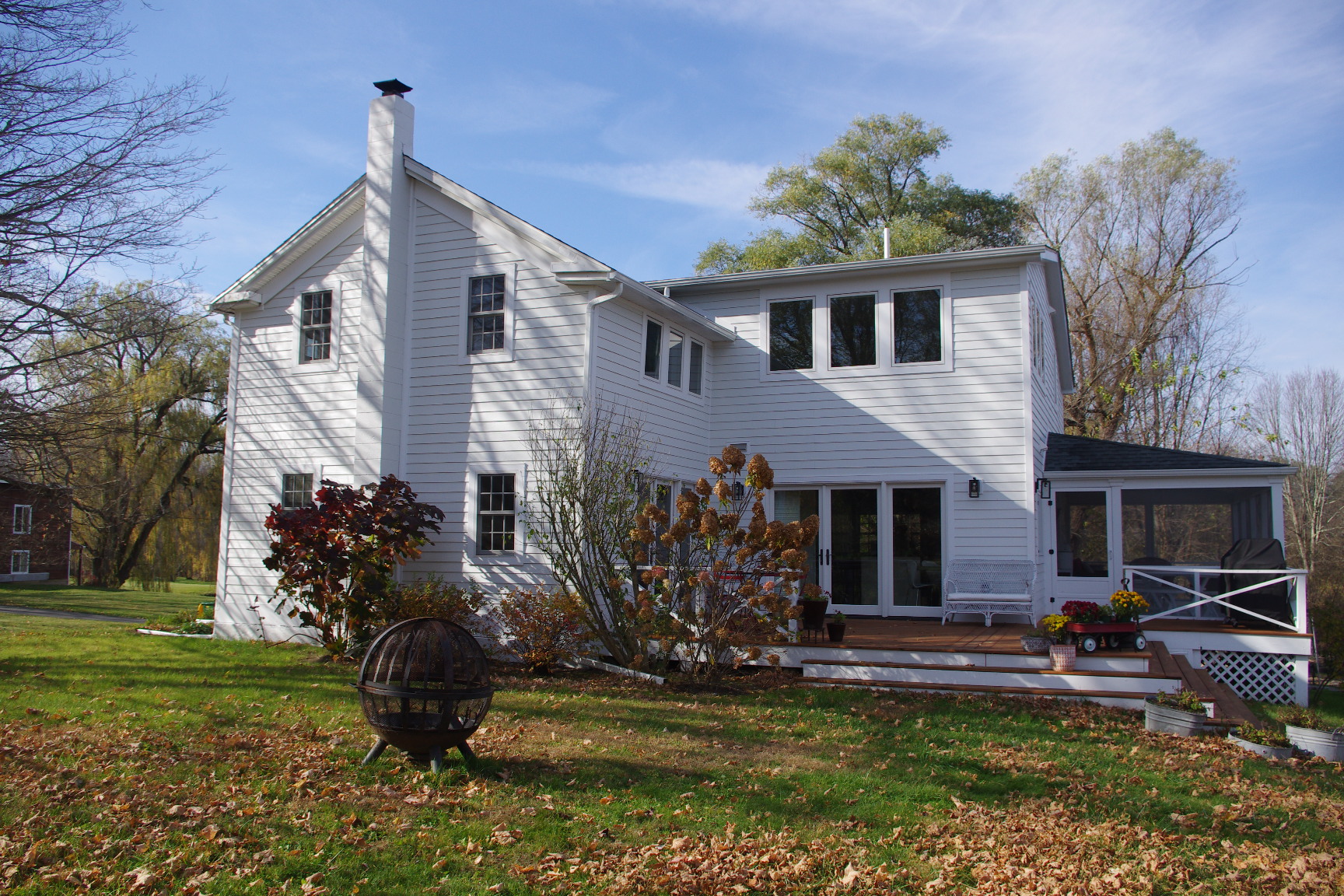
This project was a fun transformation. The home is an old Palatine home "Stella Farm" from the mid 1800s. My clients loved their weekend retreat but knew that maintanence had been defered and wished for the place to be more up to date and gracious. The design accomplished these updates while maintaining much of the old-world feel inside and toward the street.

Raised Roof over the Back Wing with New Windows


The home had a small, closed off kitchen that we expanded by removing the walled off laundry area and steep back stair. We added a triple french glass door from this beautiful new kitchen to the existing deck. Old timbers were applied to the ceiling to mimic the historic beams and the existing WIDE (really wide) board floors were refinished. The laundry was stacked in a closet and the first floor bathroom, which was akward under the stair, became a pretty wall-papered powder room.

New Expanded Kitchen with Glass Door to Deck

Sitting Area end of Kitchen with Existing Fireplace and doors to Screened Porch

Dining Nook end of Kitchen

The home's second floor was low and chopped up into strange rooms without many windows or privacy and only one bathroom. We raised the floor level and the roof over the back wing, adding height, space and light- and allowing for large windows with a view toward the pond. 

Dormer in small bedroom added height and three windows

New Back Bedroom

Existing Front Bedroom

After the renovation the home now has two large bedrooms with ensuite bathrooms and one of the two smaller bedrooms got a dormer and windows added to what was once a short, blank wall. The hall and hall bathroom also received an update.

Hall Bath 

EnSuite Bathroom from Bedroom

Powder Room


Kitchen - Before


Kitchen - Before
My clients say it feels like a whole new house! 
It has more connection to the views of the beautiful property and a better functioning floor plan.  And all this was accomplished without any increase in the footprint, just roof changes to gain more area. The home still looks and feels like itself- historic- but in a more thoughtful way. The side and front-facing windows remain double-hung style with divided lites, but for the new windows toward the back larger casement units were used to allow unobstructed views toward the pond. The exterior yellow vinyl siding was removed and white clapboards installed, the existing back screened porch and open front porch remained and were repaired, insulation was added, and the mechanical system was changed to inconspicuous, efficient heat pumps.

Garden and Privacy Fence around Heat Pumps


when the roof was torn off

during construction

Taller Wall/ Dormer adds Windows


Before the dormer


Hallway to New Back Bedroom

Built-in Shower replaces Tub

Tuesday, February 28, 2023

Roof Shape Transformation


Second Floor Area expanded and gable roof shape replaces almost-flat roof

Front view before

The shape and arrangement of the roofs at any structure greatly influences how the building looks, feels, and functions. Some existing structures, than have been added to over decades (sometimes one room at a time) can look very disorganized and overly complicated. Oftentimes when I begin a renovation or an addition to an existing older home, I have to start by thinking about the roofs.


Back view before

This home is a good example. This existing house may have started it's life as a timber barn in the late 1800s, and it was modified and added onto multiple times with varying level of skill as the owners converted it into a home, added modern amenities, and needed more space. My clients bought it thinking it could be renovated into their forever home with just a small bit of space added, so I designed a second floor addition over an area that had been only one story, and a small addition off the back. We came up with a completely new interior layout that would work for their family but even with all that, one of the most important design tactics I brought to the process was creating order from the jumble of low-pitch roofs housing low-ceilings rooms. The new home has shapes that look intentional rather than cobbled. Bringing order to what has become a mess is what a good designer can do. Part of if, for me, is looking at how the structure wants to be organized. Usually there is a logic that can be uncovered and brought forth. And this isn't esoteric - this can be about real-world solutions for shedding rain and snow as much as anything.


Back view before

I hope you can see how the change from low, almost flat roof shapes to more traditional, appropriate gabled roof shapes improved how this house looks and feels. And how, while client's eyes are focused on the floor plan, an architect is thinking in three dimensions to make a cohesive whole and can make it seem effortless. This cute building now accepts the challenge and succeeds at holding it's place in the streetscape of the historic village of which it is a part.