Showing posts with label electricity. Show all posts

Friday, October 5, 2018

Modern Farmhouse- Mechanicals & Roofing

Metal Roofing, Fascias, and Drip Edge being installed

Work continues at the New House After a Fire. Roof installation is underway along with the white fascia boards and drip edge all around the edge of the roof plane. (see the coils of metal?) The back deck - which is expansively large and accessed by 3 doors in 3 rooms - has been built, along with its railing and stair. The balconies have their decking, but don't yet have their railing. Check out the fantastic mountain view and you can see why we have these outdoor spaces.

Deck with mountain view

Balcony off back bedrooms toward view

Inside, the plumbers and electricians have been busy installing wiring, supply and drain pipes, and duct work for heating and cooling. Not pretty stuff, but we can all agree, super valuable! Some photos of their work before it all gets covered up by wall board:

Supply and Return Air Ducts and Boxes/Wiring

Bathroom Water Piping: Red/hot & Blue/cold Supply and White Drains

Air Sealing (Orange Spray Foam) around all holes

Framing for Fireplace & Hearth with Blocking for TV above


Monday, June 6, 2016

Electricity at the New House Next to the Pond

Electricity trench from pole
The New House Next to the Pond is awaiting the power company to inspect and hook up electricity to the site. (working with wired electricity powering the tools, rather than using a gas-powered generator, is preferable by far for the workers and the environment)

The trench is dug from the pole at the street, up along the side of the driveway, over the stream, to the house site.

But this house won't be buying all it's electricity from Central Hudson. There is an "off shoot" trench/conduit for a connection to where the solar panels will be located. I named this project the New House Next to the Pond, but it is could also be called the New House in the Woods; solar on the roof is not possible, as there is too much shade. So, a free-standing, grid-tied PV (photo voltaic) system is planned for the sunny meadow between the road and house.

This network - follow the red "ribbon" next to the conduit- is all connected, so the PV system can supply the house with it's power, as well as selling the excess generated electricity back to the grid for neighbors to buy and use. (and, of course, the house will draw power from the grid when it needs to, like during night)

Conduit not in trench at bridge
Off-shoot Trench leads toward Solar Panel location
Giant Spools left over from long runs of wire

Temporary meter location with house site beyond

Wednesday, April 6, 2016

Solarize!

Us with our solar panels
I went to the Tivoli "Solarize Northern Dutchess" workshop over the weekend and got re-energized on just how cool solar is.

We have a grid-tied solar generation system (PV or "photovoltaic") that was installed in January 2009. We don't use a huge amount of electricity (we use high-efficiency propane systems for hot water and base-line heat and, and a clean-burning wood stove for the majority of our heating needs) so we didn't need an enormous system. In the field behind the house and garden two masts with 8 panels each were installed to generate about 80% of our electricity annually. We did a freestanding system, as opposed to a roof-mount, as our house is surrounded by old shade trees; and the masts allow us to manually tilt the panels 4 times a year to optimize the angle to the sun and increase their production by about 20%.

Tilting the panels for different seasons
 Before I attended the Solarize event, I brushed up on my numbers. (which I'll admit, we don't really think about much after the excitement of watching the meter spin backwards wears off and we get used to the lower bills) Once a PV system is installed, it is there doing it's magnificent job of making electricity from sunlight without any moving parts or maintenance required. But I checked the inverter in the basement that counts all the electricity the system makes, and I made some calculations.

Since it was turned on, our system has produced about 33,700 KWH. At the current rate of 13c / KW delivered, that means it has saved us $4300! To be up-front, the system cost us more than that (even with all the fantastic incentives, rebates and tax credits available at the time) but that's thousands of kilowatts of energy that didn't need to be produced by a fossil fuel burning or nuclear plant, and I think that's great. And, in a few more years we will have broken even - and then for the many, many more years the system is active, we will actually be making money!

Even taking in the life-cycle costs of manufacturing and the eventual disposal of the panels and frames, solar is a very environmentally friendly product/system. Point of source power generation (making electricity at our house, to use at our house) is much more efficient than transmitting power over long distances, where much of the power generated at the plant is lost along the transmission lines. Using the sun for electricity generation makes no carbon emissions.

On the longer days of summer, we generate more power than we use, selling it back to the grid so our neighbors can use it. We buy power from the grid at night. It has a nice rhythm of give and take to it. Being grid-tied, solar becomes a community action- which is what was exciting for me about the Solarize event. If you can, I highly suggest you get solar panels.

Friday, January 15, 2016

Modern Farmhouse tranformation almost complete

Over the past few months I've been showing you pictures of a substantial renovation and addition project I've been fortunate to work on this year. This is the 6th post showing this project.

See older posts by clicking links here: #1; #2; #3; #4; #5

Well, it's almost all done, and looks great. The exterior is finished, including metal roofs over porches, exterior light fixtures and new evergreen painted doors installed.

The interior has the finished floors, plumbing fixtures, lighting, and cabinetry, and some counter tops installed. Below you can see some of these materials.

The painters are applying final coats of paint and stain. The mechanical installers are finalizing the heating and cooling systems. The carpenters are installing closet clothes rods and will soon be installing door hardware. Decorative tiles are being installed above the cook-top.

From my perspective, it's been a a relatively short time for such an all-encompassing transformation. Sometimes sitting at my desk, drawing ideas seems so far away from the job site where it actually happens, that I forget! And when I get to pop in for a site, I love seeing it all come together- seeing if the spaces look and feel like I thought they would when I dreamed it up all those months ago, and what colors my clients chose. Kudos to all who contributed to this beauty- owners, GC, and subs!

The Gallery - taken standing in Kitchen looking toward Family Room

Kitchen cabinets and counter tops
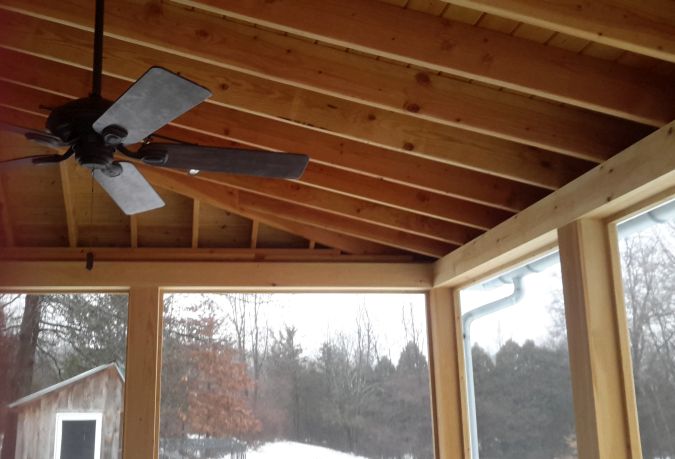
Natural wood interior at Screened Porch space
Stair that connects Rec Room to Family Room


Tile & Seat in Shower
Vaulted Board Ceiling in Master Bedroom

Monday, June 16, 2014

Final Electrical

Now that the floors and walls inside the New House Next Door have all been finished, the electrician has been on site installing the final electrical fixtures and outlets. I learned that the sub contractors like electricians and plumbers that come in after the floors are finished work in their stocking feet! The inside needs to be kept clean, so all workers now remove their outside shoes before entering.
 

Inside Garage

Barn Light being installed outside garage

 Because the garage is detached from the house, the electric runs underground to that building, and comes up out of the ground outside the north side door. These wires were pulled through the underground conduit, which was placed and buried last fall, and the garage was fitted with light fixtures and electrical outlets.

Exterior Lights are required by every door

Outside, light fixtures are placed near entrances, and convenience outlets on porches, etc. The cutest idea that was implemented was the "Christmas Light" outlet - placed up high around the front porch roof. :)
Lighting in Bathrooms over mirrow

Shoe-less Electrician installing outlet in kitchen island

Light Fixtures are required over stairs

Floor Outlets can solve furniture placement dilemmas in large rooms
 Inside, special outlets in the floor and kitchen island have been installed, as well as all the light fixtures. The building code is quite specific about light fixture and switching locations - especially at stairs and hallways - so that one can easily get around without having to fumble in the dark. The code is also quite specific about the distance between outlets, so that extension cords don't become a safety hazard. (did you ever live in an old (not updated) place where there is one outlet per room?!)

Lots of folks like to grumble about the building code - or government rules in general - and some even try to "get away with" evading the code- but these rules are there to protect health and human safety and the more I work in this field, the more I try to impress this upon my clients. Of all the sub-contractors on the job site, I think electricians are the ones I've learned from most frequently about some code requirement.


Friday, May 9, 2014

God is in the Details

"God is in the details" is a quote from famous German-American minimalist architect Mies van der Rohe.

Inside Corner, where two door casings come together

That's the stage we are at inside at the New House Next Door. I wish I could say I designed all these interior trim details in advance, but the truth is that some of the ingenious details around inside corners and such are discussed and made on site by the carpenter, Scott.

One thing I did specify is a tall baseboard and substantial three-part casing in the rooms, and then a smaller base and more minimal one-piece casing in the closets. The tall base is nearly the height of the baseboard radiators, and helps make them less obtrusive. (click to go to post about designing hide mechanicals)

Smaller beaded 1x4 casing and base in closets

Larger Three-Piece Moldings and 7 1/4" Colonial Base in Rooms


Today the stair guy is on site to install the newel posts, spindles, and handrails on the interior stair. This is very detailed, finish work and will be a real feature in the house. We discussed exactly where the newels will go and how they will be securely anchored to be really sturdy. Photos to come next time!


Also today, the electrician is on site doing the finish electric work now that all the interior painting is done around switches, fixtures and outlets. (Painters are also around caulking and touching up.) He is installing paddle switches, which I selected because of their ease of use (Universal Design - anyone can easily flip a switch, even with an elbow or shoulder)

Slides into gap @ Radiator
Meitered Return on Baseboard ...

Friday, February 21, 2014

Getting Ready for Insulation

main electrical panel (on right)

The electrician finished most of the rough in work today, including installing the electrical panel. The electrician also installed the cable/internet/phone wires for the house. All the recessed "cans" are in the kitchen ceiling, and all the electrical boxes are attached to framing in the walls.

The plumbers have installed the  vents through the roof and finished installing any pipes that are located in exterior walls. (This is only the kitchen sink drain - many of us prefer to look out a window while washing dishes- but by design we usually keep plumbing out of exterior walls, so those walls can be full of insulation instead)

With all the "stuff" that needs to go inside the exterior walls installed, The New House Next Door is ready for insulation!

Plumbing vents through the roof

Electrical boxes for ceiling lights and smoke detectors

Friday, February 7, 2014

MEP

MEP stands for Mechanical, Electrical and Plumbing.

Electrical wiring for outlets in bedrooms
 Now that the building's frame is complete, the roof is on, and the windows and doors are beginning to successfully isolate the interior space from the great outdoors, the mechanical and electrical contractors can install their materials.

The electrician did a walk-through with the clients to verify all light/outlet/switch locations and styles. Then he cab run many linear feet of wire through holes drilled in the framing. This is called the "rough in" for the electrical.

The plumber will install the pipes for the HRV in the attic space and duct it to the back gable wall. This will actively vent each of the bathrooms out and supply fresh air in at the second floor hall. Mechanical ventilation like this is required when construction is air sealed and well insulated. (ie. There is not enough passive air exchange with the outdoors through leaky walls, roofs and windows, like in my 1890s constructed home.) He also piped into each room with supply lines for baseboard radiators and installed drains for the bathrooms and kitchen.

Drains for bathrooms & supplies for baseboard heat

MEP is vital in a modern home for comfort and to be responsible and economical with natural resources. MEP can sometimes be ugly, especially if not thought through; it pays to plan early in the design process where vents, ducts, and mechanicals will go so they can integrate more seamlessly with the overall design. We want these amazing technological inventions to help make our lives better, but we don't necessarily want to see them.